
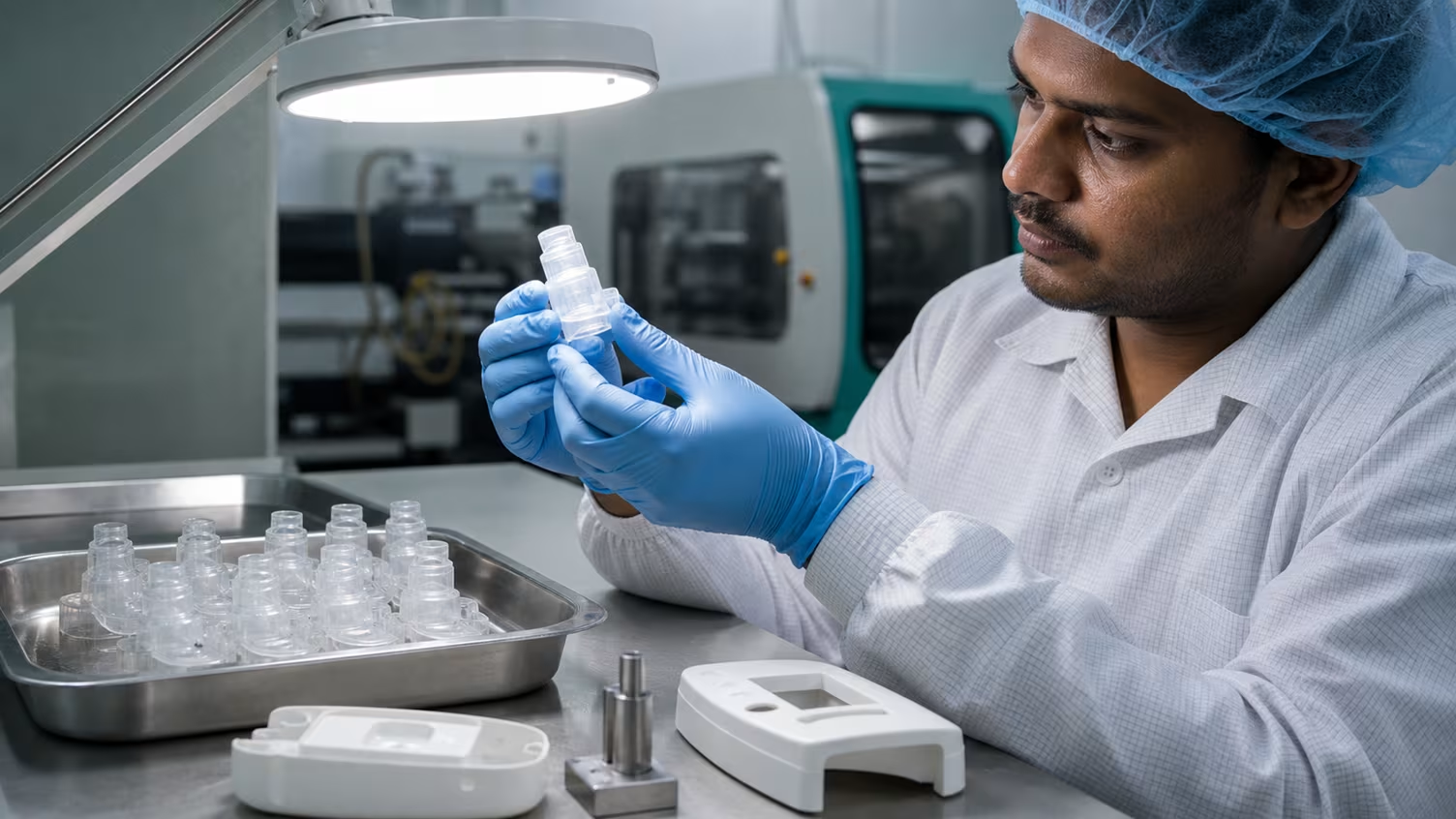
Medical Devices Are Essential Infrastructure
Medical devices are present across prevention, diagnosis, monitoring, treatment, rehabilitation, and long-term care. The sector includes very different product families—from consumables and surgical instruments to diagnostics, implants, electro-medical equipment, assistive products, and software-enabled technologies.
That diversity makes MedTech both economically important and technically demanding. Products operate at different levels of risk and may require specialised engineering, materials, software, manufacturing processes, performance or clinical evidence, quality systems, and post-market controls.
India's National Medical Devices Policy 2023 describes the sector as an essential and integral part of healthcare. The policy cited an estimated Indian market size of USD 11 billion—approximately ₹90,000 crore—in 2020 and set out a coordinated direction covering infrastructure, regulation, skills, innovation, investment, domestic manufacturing, and global competitiveness.1
The 2020 estimate should remain attached to its year. The more important message for current industry planning is the trajectory.
A Fast-Growing Market
The Department of Pharmaceuticals' Annual Report 2025–26 describes India as one of the fastest-growing markets in the global medical device industry, expected to grow at a compound annual growth rate of 15%. The report identifies India as Asia's fourth-largest medical devices market—after Japan, China, and South Korea—and among the world's top 20.2
Growth is being shaped by multiple forces: the scale and diversity of India's healthcare needs, expanding diagnosis and treatment, public and private investment, digital adoption, an active startup landscape, and growing interest in domestic production.
But market growth and manufacturing depth are not the same. A country can consume more medical technology while continuing to import much of the value.
Import Dependence Defines the Manufacturing Opportunity
In a parliamentary reply published on 17 March 2026, the Department of Pharmaceuticals stated that imports constitute around 60% of domestic medical-device consumption. The same release reported FY 2024–25 device imports of USD 8.822 billion across five broad categories.3
Electro-medical equipment accounted for the largest category in that table, followed by consumables and disposables, in-vitro diagnostics, implants, and surgical instruments. The mix matters because import dependence is not uniform across every product type. High-technology and capital-intensive categories can present very different barriers from high-volume consumables.
Another government release, using DGCIS values in rupees, reported FY 2024–25 medical-device imports of ₹137,088 crore and exports of ₹42,360 crore.4 These series should be used with care because classifications and currency presentations can differ; they are best quoted exactly with the original source rather than combined into a newly calculated market estimate.
For manufacturers, import dependence signals opportunity—but not automatic demand. A domestically made product still has to meet the intended user's needs, applicable regulation, quality and performance expectations, total-cost requirements, service expectations, and procurement conditions.
Exports Show a Second Path to Scale
The opportunity is not limited to replacing imports. In March 2026, the Department of Commerce stated that India's medical-device exports crossed USD 4 billion in FY 2024–25.5
Export growth can widen the addressable market for Indian companies and create pressure to mature product documentation, quality systems, distribution, service, and post-market processes. It can also reduce reliance on a single domestic segment.
Yet “export ready” is not a general certificate. Every target market has its own regulatory, standards, evidence, labelling, distribution, and vigilance requirements. Companies need to select markets deliberately and build the required capability into product and commercial planning.
Policy Support Is Broadening
India's medical device policy environment now includes measures relating to domestic manufacturing, common facilities, skills, research, clinical studies, parks, and production incentives.
The Department of Pharmaceuticals maintains a current Scheme for Strengthening of Medical Device Industry, including official notices and operational guidance for relevant sub-schemes.6 The Department's medical-device policy division also covers the National Medical Devices Policy, common facilities, human-resource development, medical device parks, export promotion, and other sector issues.7
For companies, scheme awareness is useful—but should be approached with discipline:
- Read the current official guideline, not an old summary.
- Check applicant, product, expenditure, location, and timeline eligibility.
- Understand whether support is reimbursement, grant, incentive, shared facility, or another mechanism.
- Build the project because it has a viable clinical, technical, and commercial case—not only because a scheme exists.
- Treat selection as uncertain until the responsible authority issues formal approval.
An association can make scheme information easier to discover and help communicate common industry feedback. It cannot guarantee selection or funding.
Regulation Begins with Risk and Intended Use
CDSCO classifies medical devices under a risk-based framework: Class A for low risk, Class B for low-moderate risk, Class C for moderate-high risk, and Class D for high risk.8
The applicable path depends on the device, intended use, claims, risk, and current rules and notifications. This is why product definition is foundational. A vague intended use can create confusion across classification, testing, evidence, labelling, risk management, and market strategy.
Manufacturers and innovators should consult the current Medical Devices Rules, official CDSCO notices, and qualified experts relevant to their product. A general article can explain concepts; it cannot determine the route for a specific device.
Quality Is More Than Passing an Audit
BIS describes IS 23485 as integrating medical-device quality-management requirements and essential principles of safety and performance. Its overview refers to risk evaluation and management, clinical evaluation, biocompatibility, software validation, and other considerations across the device lifecycle.9
The deeper point is that quality should connect the entire organisation:
- Leadership sets priorities and resources.
- Product teams translate needs into controlled requirements.
- Engineering manages design, risk, change, verification, and validation.
- Procurement and manufacturing control suppliers, processes, and traceability.
- Regulatory and clinical teams plan the evidence and submissions.
- Commercial and service teams handle training, complaints, feedback, and post-market responsibility.
When quality is treated only as documentation prepared for an inspection, weaknesses emerge later—often when changes are most expensive.
What This Means for Kerala
Kerala can contribute meaningfully to India's manufacturing ambition because it already has device companies, research capability, skilled talent, and connected strengths in rubber, electronics, biotechnology, and engineering.
The most valuable state-level interventions are those that make individual firms more capable:
- Accessible, credible testing and validation.
- Regulatory, quality, clinical, and manufacturing skills.
- Stronger medical-grade supplier capability.
- Structured links between clinical needs, research, startups, and manufacturers.
- Common infrastructure with clear access and service standards.
- Evidence-led representation of industry barriers.
- Market and export readiness built around specific product categories.
From Domestic Production to Global Trust
India's MedTech opportunity is clear: a fast-growing home market, material import dependence, rising exports, and supportive policy attention. The more difficult task is converting that opportunity into products that healthcare systems and patients can trust.
Manufacturing capacity is part of the answer. So are product relevance, evidence, quality, regulation, supply reliability, service, and continuous learning.
For KMDIA and its members, the most durable ambition is therefore not simply to make more devices in Kerala. It is to help build companies and products capable of competing on safety, performance, reliability, and value—at home and around the world.
Disclaimer
This article is for general information and industry discussion. It is not legal, regulatory, clinical, certification, procurement, tax, or investment advice. Requirements depend on the specific product and market; consult the responsible authorities and qualified professionals.
References
-
Department of Pharmaceuticals, National Medical Devices Policy 2023: https://pharmaceuticals.gov.in/sites/default/files/Gazette%20Notification%20%20National%20Medical%20Devices%20Policy%202023.pdf ↩
-
Department of Pharmaceuticals, Annual Report 2025–26: https://pharma-dept.gov.in/sites/default/files/Annual%20Report%202025-26.pdf ↩
-
Press Information Bureau / Department of Pharmaceuticals, “Medical device park”, 17 March 2026: https://www.pib.gov.in/PressReleasePage.aspx?PRID=2241167&lang=1®=3 ↩
-
Press Information Bureau / Department of Pharmaceuticals, “Import and Export of Medical Devices”, 13 March 2026: https://www.pib.gov.in/PressReleasePage.aspx?PRID=2239563&lang=2®=3 ↩
-
Press Information Bureau / Department of Commerce, medical device export ecosystem release, 14 March 2026: https://www.pib.gov.in/PressReleasePage.aspx?PRID=2240258&lang=2®=48 ↩
-
Department of Pharmaceuticals, Scheme for Strengthening of Medical Device Industry: https://pharma-dept.gov.in/schemes/scheme-strengthening-medical-device-industry ↩
-
Department of Pharmaceuticals, Medical Devices Policy Division: https://pharma-dept.gov.in/policy-medical-devices ↩
-
CDSCO, Medical Device & Diagnostics: https://www.cdsco.gov.in/opencms/opencms/en/Medical-Device-Diagnostics/Medical-Device-Diagnostics/ ↩
-
Bureau of Indian Standards, IS 23485 overview: https://www.bis.gov.in/bis-publishes-is-23485-medical-devices-quality-management-system-requirements-and-essential-principles-of-safety-performance-for-medical-devices/?lang=en ↩